JKPSC Exams . What to Study. Passing the JKPSC
As the 2026 JKPSC Exams approach, the pressure to perform is at an all-time high. With the introduction of evolving exam patterns and a shift toward clinical reasoning, many students find themselves overwhelmed. The key to success isn't just studying hard—it’s studying smart.
You are preparing JKPSC Exams, having a concise, revised, and focused strategy is the only way to navigate the vast syllabus of all subjects.
The Dilemma: What to Read?
The most common question every aspirant asks is: “Which books should I consult?” While building a foundation requires standard textbooks, your revision should be anchored in high-yield facts.
Standard Reference Books for Foundation:
- Basic Sciences: BD Chaurasia (Anatomy), Ganong (Physiology), Harper (Biochemistry).
- Para-Clinical: Robbins (Pathology), Park (SPM), Parikh (Forensic).
- Clinical: Harrison & Davidson (Medicine), Bailey & Love (Surgery), OP Ghai & Nelson (Pediatrics), Khurana (Ophthalmology).
A Focused Approach to the New JKPSC Exam Pattern
The 2026 examination landscape focuses heavily on Latest Examination Type Questions. To stay ahead, your preparation must cover:
- Clinical Case Scenarios: Moving beyond rote memorization to bedside application.
- Image-Based Questions (IBQs): Identifying pathologies via X-rays, MRIs, and histopathology slides. Very Few
- Values & Constants: Memorizing critical biochemical and physiological ranges.
- Conceptual & Problem-Based Questions: Understanding the "why" behind the "what."
- One-Liners: Quick memory-based facts for rapid-fire scoring.
Subject-Wise Coverage
To ensure a complete revision, our programme covers the most frequently asked topics across all essential pillars:
- Pre-Clinical: Anatomy, Physiology, and Biochemistry.
- Para-Clinical: Pharmacology, Pathology, Microbiology, Forensic Sciences, SPM.
- Clinical: Medicine, Surgery, Gynae/Obs, Pediatrics, Orthopedics, Ophthalmology, Radiology, and Psychiatry.
Recapitulating high-yield points at the end of your study session is vital. Try these sample questions based on the latest patterns:
Final Pro-Tip for 2026 JKPSC Aspirants
Recapitulation is the mother of memory. As the exam date nears, stop picking up new, bulky textbooks. Focus on concise, revised modules that highlight "high-yield" points. Avoid the confusion of the new pattern by sticking to a program that integrates clinical cases with simple one-liners.
Gear up, stay focused, and prioritize the topics examiners love to ask!
Strategic Preparation: What to Read
A basic hurdle for any aspirant is deciding which books to consult. While revision notes are vital, they should be supplemented by the gold standards of medical literature.
Standard Reference Books:
- Anatomy: BD Chaurasia
- Physiology: Ganong
- Biochemistry: Harper
- Pathology: Robbins
- Medicine: Harrison / Davidson
- Surgery: Bailey & Love / Shwartz
- Pediatrics: OP Ghai / Nelson
- SPM: Park
- Forensic Sciences: Parikh
Key Question Patterns for 2026
To succeed, students must practice diverse question formats:
- Clinical Cases: Bedside scenarios and diagnostic dilemmas.
- Image-Based Questions: Identifying pathologies through visual data.
- Conceptual & Problem-Based: Testing deep understanding rather than rote memory.
- One-Liners: High-yield memory facts for quick points.
Conclusion: Recapitulation is Key
The final phase of preparation should be dedicated to recapitulating high-yield points. Use JKPSC site and updated Links to stay updated on exam notifications and pattern changes. Focus on your weak areas, practice clinical vignettes daily, and ensure you are familiar with the latest 2026 JKPSC question types.
📢 NOW AVAILABLE IN SRINAGAR! 📘
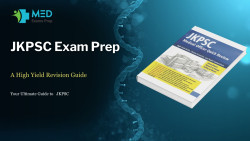
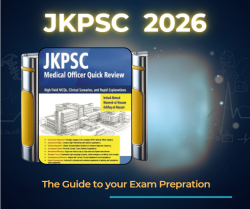
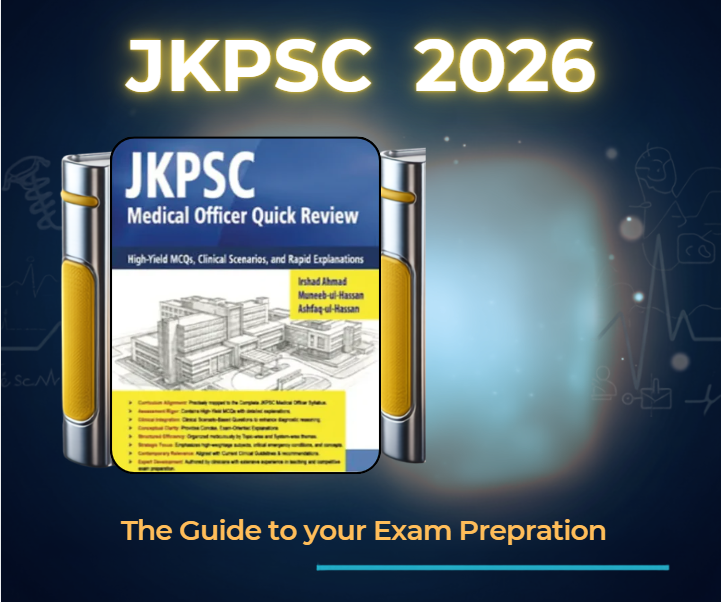
JKPSC Medical Officer Quick Review
✨ High-Yield Q Bank & Rapid Review
📚 Strictly as per JKPSC MO syllabus
📍 Available at:
Bisma Book Shop, Bemina, Srinagar
➡️ Opposite Govt. Degree College, Bemina
📞 Contact: 70066 97115